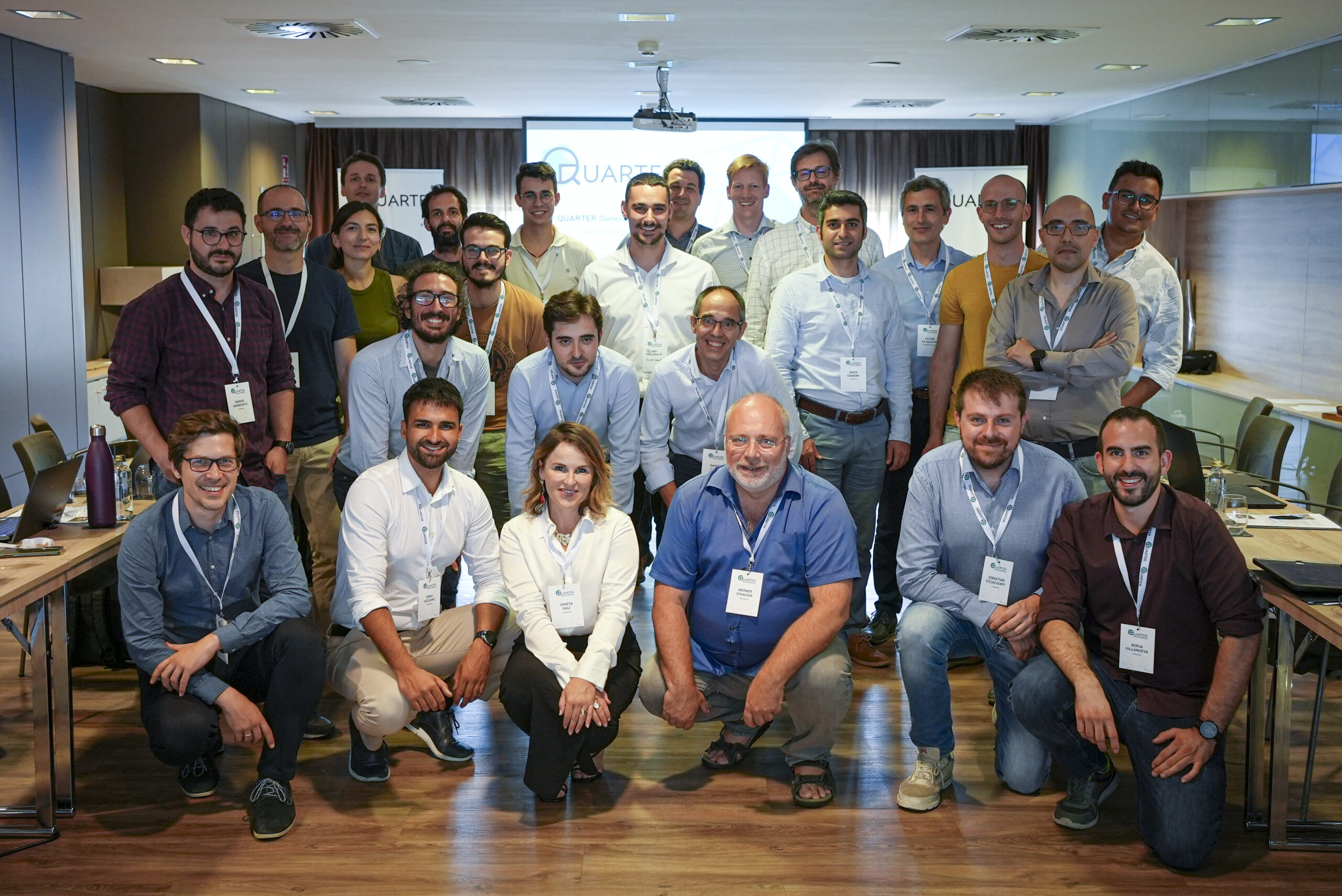
April, 2026. Barcelona — The QUARTER project, an EU-funded research and innovation initiative under the Digital Europe Programme (DEP), has concluded after three years, having successfully exceeded its original targets and significantly advanced the maturity of quantum-safe communication technologies in Europe.
Led by Luxquanta, QUARTER was launched to accelerate the transition of Quantum Key Distribution (QKD) and enabling technologies from laboratory-stage developments to commercially deployable, industrially validated solutions ready to support Europe’s future Quantum Communication Infrastructure (EuroQCI).
The consortium brought together Luxquanta, Chilas, Quside, Thales, Telefónica Innovación Digital, fragmentiX, Cipherbit-Grupo Oesía, and AIT Austrian Institute of Technology, combining expertise across QKD systems, photonic components, network security, telecom integration, certification, and standards with leading companies, SMEs, and technology organizations.
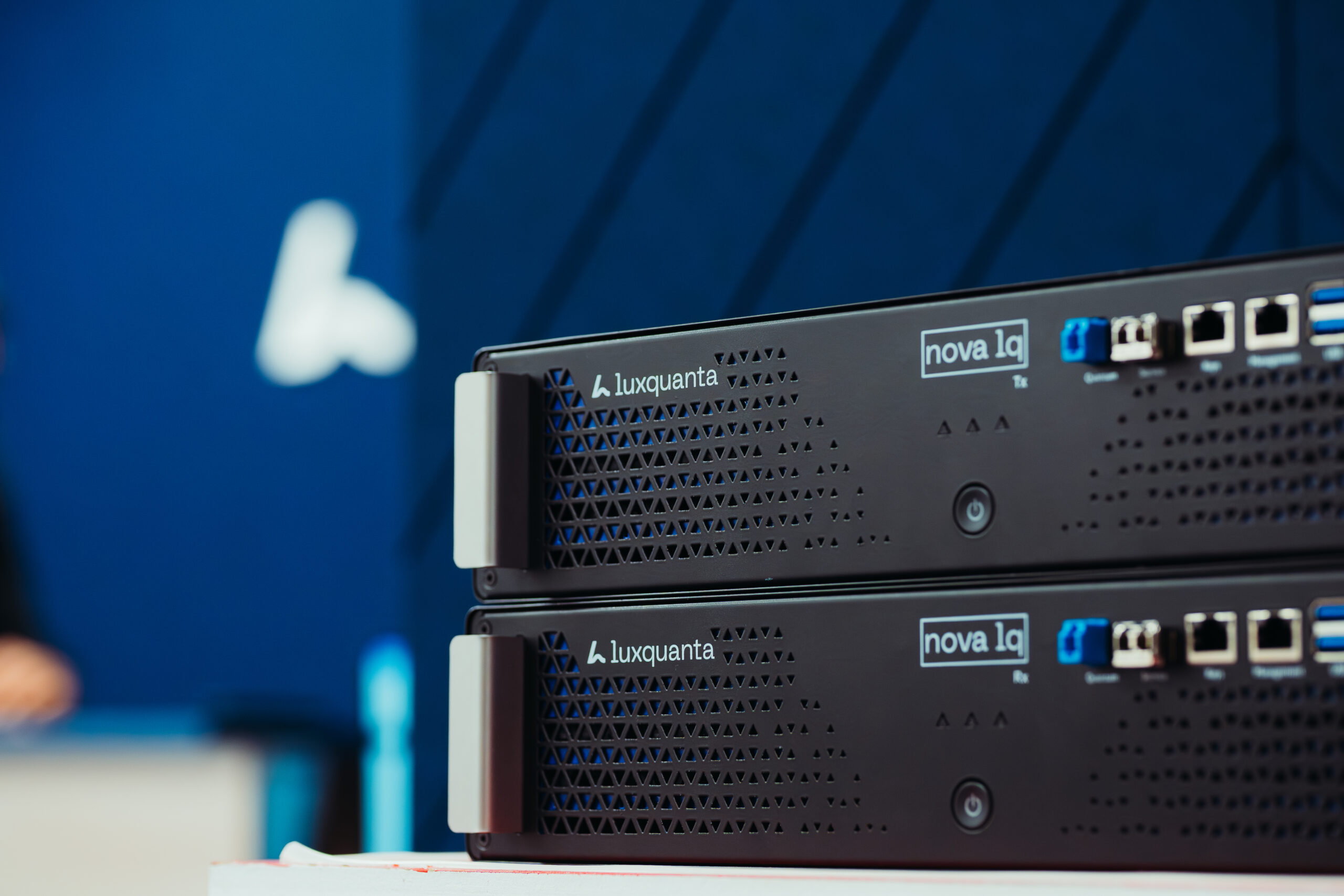
At the core of the project was the maturation of Luxquanta’s continuous-variable QKD (CV-QKD) technology. Over the course of QUARTER, the system advanced from a laboratory prototype into a carrier-grade commercial product designed for operation in real telecom environments. The system was launched in March 2023 and upgraded to a second generation in March 2025. The project results exceeded the expected channel loss tolerance of 12 dB set at the beginning of the project. The system was validated for operation over link distances up to 100 km, equivalent to 20dB of Channel Losses, 8 dB more than originally targeted. QUARTER also validated the coexistence of the quantum channel with classical data traffic on standard optical fiber, a key step toward more cost-effective deployment without requiring dedicated dark fiber.
In parallel, Luxquanta consolidated the product for industrialization through a redesigned architecture, improved reliability and usability, stronger quality assurance processes, embedded security functions, and a reduced 2U rack-mount form factor suited to operational environments.
QUARTER also made major progress in critical photonic components, reinforcing the European quantum supply chain. Quside advanced its Quantum Random Number Generator (QRNG) technology, achieving the project target of 2.4 Gb/s and strengthening integration efficiency, stability, and performance. Chilas matured its narrow-linewidth photonic integrated circuit laser technology, meeting the power, linewidth, and tunability requirements needed for CV-QKD applications. Together, these results represent a significant advance in the availability of European-developed components for quantum communication systems.
Certification and compliance were another major outcome. Quside’s QRNG achieved NIST SP 800-90B certification in August 2024 and was approved by the Spanish National Cryptologic Center (CCN) in February 2025, marking important milestones for trust and market readiness. Chilas completed electromagnetic compatibility evaluation for its laser module and achieved laser safety compliance, while Quside also completed EMC testing and environmental validation for telecom and datacenter conditions. These results support the transition from innovation to certified, real-world-ready technology.
Beyond hardware maturity, QUARTER addressed the broader system architecture required for quantum-safe communications. AIT, the Austrian Institute of Technology, developed a feature-complete Key Management System (KMS) that supports QKD, post-quantum cryptography, and hybrid keying, and is aligned with ETSI standards. Thales upgraded its encryptors and supported interoperable end-to-end security architectures, validating interfaces between QKD and KMS environments. fragmentiX developed a secret-sharing appliance and software stack that provides information-theoretic protection of data at rest and validated integration with QRNG as a source of randomness. Telefónica Innovación Digital defined a layered SDN-based orchestration architecture to support QKD integration into software-defined network environments.
QUARTER also ensured that these technologies were validated beyond isolated development. The consortium established a framework of interoperability, end-user, functional, and security parameters to support integration into modern network infrastructures. In addition, QUARTER technologies participated in a series of multi-vendor demonstrations organized in collaboration with PETRUS, the EuroQCI coordination and support action. These demonstrations, showcased at events such as the DIGITAL EU Assembly, ECOC, and EQTC, progressively increased in complexity and provided visible proof that quantum-safe systems from multiple vendors can interoperate in “mini-EuroQCI” scenarios.
Industrialization remained a central pillar of the project. Feedback from consortium partners, including Telefónica Innovación Digital and Cipherbit-Grupo Oesía, as well as external proofs of concept and national EuroQCI deployments, helped refine the technology for operational use.
QUARTER further generated a strong body of research and academic output, with scientific contributions published in peer-reviewed journals and major conferences. This scientific output demonstrates that the project combined rigorous research with a clear path toward deployment-ready technology.
In addition to technical development, QUARTER validated its progress through a number of field demonstrations and proofs of concept in healthcare, data center, cloud, telecom, and finance-related environments. The project also explored a lawful interception use case within a Telefónica QCI environment, integrating OpenLI – an ETSI compliance software – fragmentiX secret-sharing technology, and Thales IPsec devices to support secure audit-log management and storage.
At the end of the project, QUARTER’s efforts resulted in the hiring of 53 professionals across consortium members and generating broad visibility through conference participation, industry engagement, and international press coverage. More broadly, the project strengthens European competitiveness and strategic positioning by maturing a full stack of EU-developed and EU-manufactured quantum-safe technologies and reinforcing the foundations of a more sovereign European value chain.
In line with the European Commission’s goal, QUARTER has successfully demonstrated a full evolution from prototype to product, from component R&D to certification, and from research ambition to industrial readiness. Its results provide a concrete step forward for Europe’s quantum-secure communications capabilities and for the continued rollout of the EuroQCI initiative.
Read the full blog post here:
EU-funded QUARTER Project exceeds all targets, maturing quantum-safe technologies