
April, 2026. Barcelona – The QUARTER project, an EU–funded research and innovation initiative under the DIGITAL Europe Programme (DEP), ends after three years. The project successfully matured Quantum Key Distribution (QKD) from laboratory prototypes into commercially deployable, industrially validated technology, exceeding all of its original performance and key milestone targets.
Led by Luxquanta, manufacturer of continuous-variable QKD (CV-QKD) systems, QUARTER’s main objective was to advance the maturity level of quantum-safe communication technologies, including QKD systems, photonic-integrated components, and classical security solutions. The developments had to deliver functional technology, enabling industrialization and network integration for operation across the European quantum communication infrastructure (EuroQCI).
The consortium was formed by four SMEs — Quside, Luxquanta, Chilas, and fragmentiX —specialized in QKD systems and critical photonic components, together with four large companies and research and technology organizations: Thales, Telefónica Innovación Digital, Cipherbit–Grupo Oesía, and the AIT Austrian Institute of Technology.
The technological impact of QUARTER activities has enabled consortium members to establish a comprehensive framework of end-user, interoperability, functional, and security parameters, aiming to ensure the integration of the developed technologies into modern network infrastructures.
TECHNOLOGICAL IMPACT AND QKD MATURITY READINESS LEVEL
QUARTER’s core technology development focused on Luxquanta’s CV-QKD technology, which integrates directly into existing optical networks without requiring dedicated dark fiber. Over the course of the project, Luxquanta has matured its CV-QKD prototype into a commercial product. The key performance results of Luxquanta are, in essence:
- QKD operation over link distances up to 100 km: The project results exceeded the expected channel-loss tolerance of 12 dB set at the beginning of the project. The system was validated for operation over link distances up to 100 km, equivalent to 20dB of Channel Losses, 8 dB more than originally targeted.
- Quantum channel coexistence with classical data traffic: Systems were successfully tested in existing optical fiber networks, confirming that the quantum channel can coexist with classical communication traffic. This feature eliminates the need for dark, dedicated fiber for QKD links, directly reducing both capital expenditure (CAPEX) and operational expenditure (OPEX) when deploying quantum-safe communications links in operational networks.
- Enhanced security architecture: by integrating advanced security functionalities, including secure authentication and embedded post-processing. This improvement reduces reliance on external general-purpose hardware.
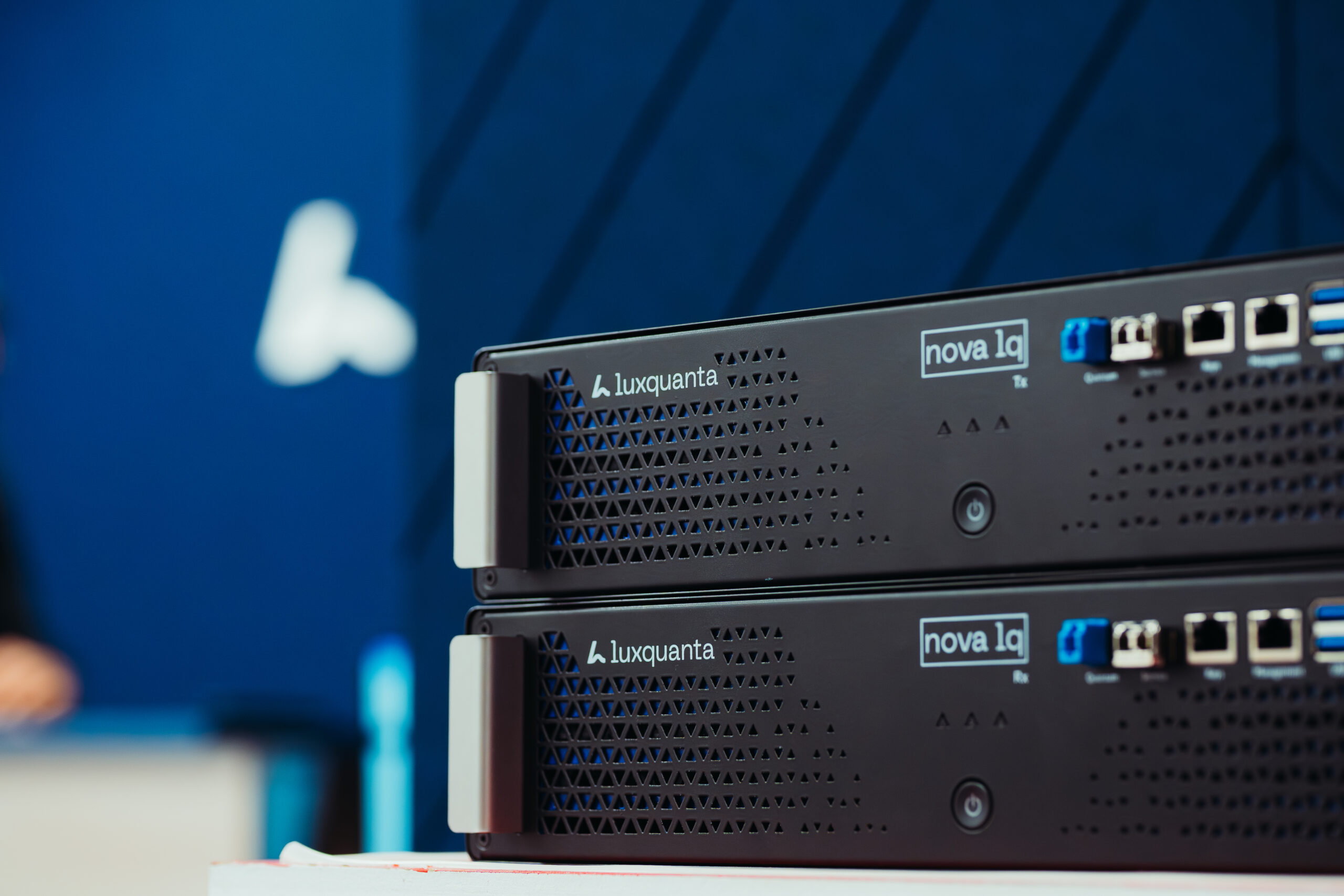
- Product Consolidation: Luxquanta’s CV-QKD prototype was matured into a commercial, carrier-grade system launched in March 2023 and upgraded to a second-generation system launched in March 2025. The evolution improved reliability and usability while strengthening production and quality assurance processes. The system has also undergone an industrial redesign to streamline its internal architecture and reduce its external form factor to a compact 2U standard rack unit.
PHOTONIC COMPONENTS AND EU SUPPLY CHAIN
QUARTER strengthened the European photonic ecosystem by maturing critical photonic-integrated components suitable for quantum communication systems. The project advanced Quantum Random Number Generator (QRNG) and narrow-linewidth PIC lasers, strengthening the European quantum supply chain and supporting Europe’s ambition for technological sovereignty in quantum communications
Quside, a developer of quantum random number generators (QRNGs), and Chilas, a manufacturer of advanced laser sources, led the work on photonic components with the following objectives met:
- High-performance QRNG modules: based on photonic integrated circuits (PICs), Quside achieved a generation rate of 2.4 Gb/s as targeted, with advances in linewidth, wavelength stability, and integration efficiency. The innovation in these technologies, validated in QKD systems, directly improves the reliability and security of QKD.
- Certification for QRNG technologies: Quside’s QRNG achieved NIST SP 800-90B certification in August 2024 and was approved by Spain’s National Cryptologic Center (CCN) in February 2025. Electromagnetic compatibility (EMC) testing was also completed, validating the component’s robustness for real-world deployments. These advancements in certification are critical to continuing to build the needed milestones for trust and market readiness.
- Narrow-linewidth PIC lasers: Commercial lasers from Chilas at the start of the project did not meet all the specifications required for CV-QKD. The project has concluded with lasers reaching while meeting CV-QKD requirements for power, linewidth, and tunability.
INTEROPERABILITY AND END-TO-END SECURITY
Quantum-safe communications depend on a fully integrated and validated technological ecosystem. QUARTER placed strong emphasis on interoperability, orchestration, and real-world deployment across the entire quantum-safe stack. Contributions from Luxquanta, AIT, Telefónica, fragmentiX, and Thales were key to ensuring seamless interoperability in EuroQCI deployments.
Key achievements include:
- Secret-sharing appliance: Secret sharing provides an information-theoretic protection of data at rest, even against Quantum Computers. The work at QUARTER by fragmentiX resulted in full development of the cryptographic software stack and implementation of a new high-performance secret-sharing algorithm. Sharing appliances integration was also validated for integration with QRNG as a randomness source.
- Encryptor upgrade: Upgraded encryptors by Thales and a fully interoperable end-to-end security architecture were validated through field demonstrations, confirming the robustness of the overall solution across real-world conditions. Thales also supported the ETSI GS QKD 014 and GS QKD 004 interfaces, enabling interoperability between QKD and KMS systems. Upgraded encryptors and a fully interoperable end-to-end security architecture were validated through field demonstrations, confirming the robustness of the overall solution across real-world conditions
- Key Management System. AIT developed a feature-complete KMS that supports QKD, post-quantum cryptography (PQC), and hybrid keying, with SDN interfaces for orchestration and lifecycle management. was developed by AIT. Aligned with ETSI standards GS QKD 014 and GS QKD 004, it supported hybridization with post-quantum cryptography (PQC) and integration with software-defined networks
- SDN integration: TID defined a layered QKD orchestration architecture, aligned with ETSI GS QKD 015, via dedicated Luxquanta API endpoints.
MULTIVENDOR INTEROPERABILITY DEMONSTRATIONS
Complementary to the technological innovation, the interoperability features were proven in collaboration with other DEP projects. These demonstrations were aligned with the activities of the project PETRUS (link to petrus) under the coordination and support actions (CSA) call for EuroQCI deployments.
The first demonstration took place in 2023 at the DIGITAL EU Assembly in Stockholm, with Luxquanta’s QKD systems connected to other vendors’ systems via a KMS. The Stockholm event brought together the most influential stakeholders within the European Commission working to advance Europe’s quantum-safe strategy.
PETRUS progressively expanded its demonstrations at flagship conferences such as ECOC and EQTC, ultimately reaching the most ambitious setup at ECOC 2025. This last demonstration featured 7 interconnected domains, with 9 QKD providers and 8 KMS providers, including Luxquanta’s QKD and AIT (Austrian Institute of Technology) KMS.
These demonstrations established both the foundation and real-world proof of the technology readiness of quantum-safe communications. They served as live evidence of the technology’s practicality and maturity for industry, end-users, and policymakers.

INDUSTRIALISATION AND PRODUCTION READINESS
QUARTER supported Luxquanta’s NOVA LQ® from prototype to a series-manufactured commercial product, reaching industrialization levels by the end of the project. Quality assurance processes were strengthened across both development and production workflows. It established a clear pathway toward large-scale industrialization and EuroQCI’s advancement of standards compliance, certification preparation, supply-chain analysis, and production processes aligned with carrier-grade requirements.
- Industrialization measures: evaluation of supplier capabilities and reliability, adoption of a formal system development process with defined requirements and test plans, and strengthened quality assurance in development and manufacturing.
- Design-for-manufacture and production readiness of QKD systems: integration of design-for-test and design-for-manufacturability features, and product improvements such and secure remote upgrade capabilities, supporting reliability, maintainability, and efficient customer support in the event of failures.
- Deployment-driven refinement: improvements informed by feedback from QUARTER partners (TID, Cipherbit) and deployments with external users, including systems delivered through national EuroQCI projects and multiple PoCs.
STANDARDISATION, CERTIFICATION, AND EUROPEAN RELEVANCE
QUARTER made sustained contributions to European and international standardization, with key involvement from Cipherbit and Luxquanta. The consortium provided continuous input to ETSI ISG QKD and related bodies, shaping emerging standards for quantum communication technologies. Interfaces and monitoring frameworks developed within the project were aligned with these standards to ensure interoperability and long-term compatibility.
Most significantly, technologies developed within QUARTER are already deployed in national Quantum Communications Infrastructure (QCI) testbeds and operational environments across Europe, directly supporting the first deployments of the EuroQCI initiative under the Digital Europe Programme.
- Compliance and certification progress: continued assessment of standards compliance for QKD, secret-sharing, and QRNG; Quside’s QRNG achieved NIST SP 800-90B certification (August 2024) and approval by the Spanish National Cryptologic Center (CCN) (February 2025).
- Standardisation contributions: active participation by TID and LuxQuanta in ETSI ISG QKD, including inputs to ETSI QKD 023 on QKD monitoring
- Electromagnetic Compatibility (EMC) Evaluation: Chilas completed the EMC evaluation IEC 61000 / EN 55011 for the laser module, while also getting approval for laser safety compliance under EN 60825-1 (Class 1M). In parallel, Quside also conducted EMC tests to verify QRNGs compliance with standards EN 55032 and EN 55035, confirming robust operation under electromagnetic stress, demonstrating successful compliance with Class A EMC limits.
- Safety compliance of QRNG for datacenters and Telecoms Infrastructure: Quside confirmed stable long-term operating conditions, guaranteeing reliable performance in real-world environments over time.

In addition to the R&D efforts to comply with standards, QUARTER members also actively particiapted in ETSI meetings & events
RESEARCH CONTRIBUTION & ACADEMIC OUTPUT
The research and innovation work required to meet the ambitious goals of the consortium has provided research contributions to academia, generating a strong and growing body of scientific literature.
At the end of the project, a total of eight academic contributions have been published in peer-reviewed journal articles and industry conferences. The papers have been presented in some of the most relevant venues in optical communications, network security, and quantum technologies.
The work can be segmented into three main areas of research:
- Coexistence of CV-QKD systems with classical optical infrastructure: multiple papers address how CV-QKD can operate alongside high-capacity DWDM and FOADM-based metro networks, presented at flagship conferences including ECOC 2024 and OFC 2024 & 2025. This work is critical to present the foundations of practical QKD deployment in real-world scenarios. Melgar et al. (2024), Melgar et al. (2025), Iqbal et al. (2025), Adillon et al (2024)
- Signal processing: advances of the state of the art in phase noise reduction and phase recovery for CV-QKD systems, with dedicated contributions at ICTON 2024 and OFC 2024, and a further paper on a low-complexity phase-diversity homodyne receiver accepted for presentation at ICTON 2025. Sarmiento et al. (2024), Llanos et al. (2024), Adillon et al. (2025)
- Key Management System research: addressed the network-layer challenge of managing cryptographic keys generated by QKD systems across large-scale deployments. This contribution establishes the architectural foundations for scalable, secure key management in large-scale real-world QKD network deployments. (James et al., 2023)
QUARTER successfully achieved to generate rigorous, internationally recognized scientific output while maintaining a clear line of innovation in deployment-ready quantum-safe communications.
FIELD DEMONSTRATIONS
Technological innovation, improvement, and industrialization received constant feedback from field demonstrations and proofs-of-concepts across different environments and targeted use cases. A total of four deployments were validated in collaboration with external partners and industry players: The goal was to test the maturity of QKD technology in real-world scenarios across target sectors that will benefit from Quantum Security, expanding the scope beyond the Governmental EuroQCI deployments.
- Healthcare: Secure connectivity between Hopsitals from VITHAS Foundation in collaboration with Telefónica and KMS provider Qoolnet. The field deployment was deployed in real infrastructure.
- Data Centers & AWS Cloud: Secure Data Center interconnection and AWS Cloud Access.Field demonstration in collaboration with Juniper Networks, lyntia, and Merqury Cybersecurity..
- Data Centers, Hollow-Core Low Latency Fibers: in collaboration with OFS Furukawa Solutions, NOKIA, Digital Realty, evolutionQ & IDQuantique. Test of CV-QKD developed under QUARTER project with low-latency fibers, targeted to data center usage.
- Banking & Finance: Quantum-safe IPSec connection between banking institutions using QKD & PQC.
The project featured as main use case lawful Interception, which refers to the legally authorized access to private communications by national authorities in exceptional circumstances. In other words, it is a security process by which a service provider or network operator collects and delivers intercepted communications to law enforcement officials. This mechanism is required under the European Council Resolution of 1995.
The field demonstration was deployed within the Telefónica QCI network environment, consisting on three main nodes interconnected by QKD-links. It operates as follows:
- OpenLI, an ETSI-compliant software, sends interception logs to the fragmentiX appliance.
- fragmentiX splits the data and distributes each fragment across three Telefónica QCI locations: Distrito, Norte, and Concepción.
- Quantum-safe IPsec tunnels are established between Thales Mistral IP9001 devices to connect the different locations.
SOCIETAL IMPACT AND WORKFORCE DEVELOPMENT
QUARTER efforts, supported by the EU, had a direct societal impact with 53 professionals hired across consortium members, stimulating the quantum market ecosystem in Europe.
The dissemination of project activities and active participation in industry events directly reflected the project’s emphasis on societal impact. With the goal of stimulating the industry and raising awareness across sectors and audiences, consortium members participated in almost 50 conferences and events, with QUARTER being featured internationally in over 40 press mentions in 28 media outlets.
Engagement spanned national and European authorities, policymakers, and EuroQCI program stakeholders, ensuring that QUARTER’s outcomes directly inform main decision-makers and national quantum infrastructure representatives.
EUROPEAN COMPETITIVENESS AND STRATEGIC POSITIONING
QUARTER’s results position Europe to compete globally in quantum-secure communications. By maturing a full stack of EU-developed and EU-manufactured technologies and advancing the maturity of the EU quantum industry value chain, the project helps reduce Europe’s dependence on non-European suppliers and establishes the technical foundation for upcoming projects and the continued completion of the EuroQCI initiative.
Some of the Media outlets that cover the launch of the QUARTER Consortium project in 2023.
